

Jaw Pain (TMJ) Treatment in Hursville
Where Do You Feel Jaw Pain?
Jaw pain can be felt in different areas depending on the structures involved. The location of pain can provide useful clues, although symptoms often overlap and the location alone does not determine the cause.
1. Around The Jaw Joint (TMJ)
May be associated with
-
TMJ-related pain (arthralgia)
-
Pain involving structures around the jaw joint.
Commonly aggravated by
-
Chewing
-
Biting solid foods
-
Yawning
-
Opening the mouth widely
3. Around The Temple
May be associated with
-
Temporalis muscle pain
-
Headache associated with TMD
Commonly aggravated by
-
Chewing
-
Prolonged talking
-
Clenching
-
Grinding
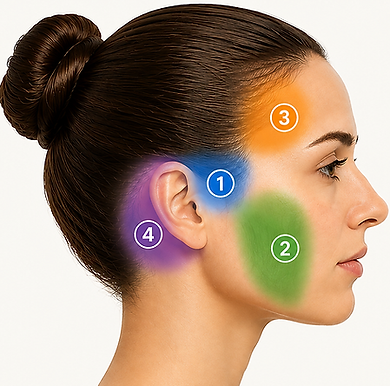
2. In The Cheek
May be associated with
-
Masseter muscle pain
Commonly aggravated by
-
Chewing
-
Prolonged talking
-
Clenching
-
Grinding
4. Around The Ear
May be associated with
-
Referred pain from the jaw joint or muscles
Commonly aggravated by
-
Chewing
-
Prolonged talking
-
Yawning
-
Opening the mouth widely
Understanding Jaw Pain (TMD)
1. What is TMD (Temporomandibular Disorders)
Temporomandibular Disorders (TMD) is an umbrella term for a group of conditions involving the jaw joints (TMJs), chewing muscles, and associated structures. Jaw pain can involve more than one structure and may present differently from person to person. Symptoms can overlap, and more than one type of TMD may be present at the same time.

Headache Associated with TMD
Jaw Joint Pain
(Arthralgia)
Jaw Muscle Pain
(Myalgia or Myofascial Pain)
Jaw Movement (Clicking or Locking)
2. What Symptoms Can Occur With TMD?



3. What Can Influence TMD?
TMD is better understood as a multifactorial condition, with different factors potentially contributing from person to person. Some factors may be associated with the development of TMD, while others may influence pain, symptom persistence, or recovery.

Clenching or Grinding
Frequent or sustained clenching and grinding may increase jaw muscle activity and loading and may contribute to pain, fatigue, or stiffness in some people. However, bruxism and TMD are not the same condition. Bruxism can occur without TMD, and TMD can occur in people who do not clench or grind.

Stress & Emotional Wellbeing
Stress, anxiety, and emotional wellbeing may influence pain sensitivity, muscle activity, sleep, coping, and behaviours such as clenching or jaw guarding. These factors are rarely the sole cause of TMD, but they may influence how symptoms develop, persist, or are experienced as part of a broader biopsychosocial picture.

Previous Injury or Direct Trauma
Previous injury involving the jaw, face, head, or neck may be relevant in some people with TMD. This may include sporting injuries, motor vehicle accidents, whiplash, previous jaw injuries, or other events involving significant loading or prolonged opening of the jaw.

Neck Pain & Function
People with TMD may experience neck pain, stiffness, muscle tenderness, or changes in neck function. Research has reported differences in cervical movement, muscle function, and neck-related disability in people with TMD. However, having neck pain does not necessarily mean that the neck is the cause of the jaw problem.

Sleep & Recovery
Poor sleep may be relevant to TMD in some people and may also influence pain sensitivity, fatigue, mood, and recovery. Sleep-related problems can occur alongside TMD, but this does not mean that poor sleep directly causes TMD in every person.
Common Questions About Jaw Pain
-
Not recommended for chronic TMD pain
-
Maybe considered for dental protection from bruxism

-
Not recommended for chronic TMD pain (Botulinum toxin, trigger point injections, corticosteroid injections, and hyaluronic acid injections)

-
Not considered 1st-line care for TMD
-
Maybe considered in cases involving specific joint pathology or particular clinical indications


When Should I Seek Further Care?
Most jaw pain can be managed conservatively, but some symptoms may require further assessment or care from another healthcare professional.
A GP assessment may be appropriate when further medical investigation or medication management is required, or when symptoms do not fit a typical musculoskeletal TMD presentation, such as unexplained swelling, fever or systemic symptoms, persistent or unexplained facial pain, neurological symptoms, or other concerning changes.
A dental assessment may be appropriate when symptoms could be related to the teeth, gums, or other dental structures, such as tooth-specific pain, sensitivity to hot or cold, pain when biting, dental swelling, suspected infection, damaged teeth, or concerns about significant tooth wear from grinding.
Specialist assessment may be appropriate for significant or persistent jaw locking, substantial restriction in mouth opening, recurrent dislocation, significant joint pathology, trauma, or symptoms that have not responded as expected to appropriate conservative management.
A psychologist may form part of collaborative care when stress, anxiety, pain-related fear, sleep difficulties, or other psychological factors are having a significant impact on pain, daily function, or recovery.
How We Help With Your Jaw Pain
1. Thorough Assessment
Every person experiences neck pain differently. Rather than simply looking for something "out of place," our assessment aims to understand what may be contributing to your symptoms and determine the most appropriate management plan for you.

Detailed history

Movement assessment

Hands-on assessment

Muscle strength test

Neurological assessment

X-ray if indicated
2. Understanding Your Conditions And Making Sense Of Your Jaw Pain
Jaw pain is rarely influenced by one factor alone. At Motion Wellness, we help you make sense of your symptoms, understand the factors that may be contributing to your condition, and identify practical strategies that may help support your recovery.

3. Personalised Management
At At Evergreen Spine & Wellness, our approach aligns with current clinical guidelines, starting with a conservative approach for people with persistent TMD pain. Your management plan is tailored to your symptoms, clinical findings, contributing factors, needs, and goals.

Manual therapy may be used when appropriate to help improve comfort, reduce pain sensitivity, and support movement.
-
Chiropractic adjustment
-
Joint mobilisation
-
Manual stretching
-
Soft tissue therapy

Individualised exercises designed to improve movement, physical capacity, and confidence.
-
Jaw exercises
-
Breathing exercise
-
Stretching exercises
-
Neck mobility exercises

Jaw pain can be coming from various factors, including jaw conditions, stress, sleep and activity.
-
Jaw clenching & grinding
-
Stress management
-
Sleep intervention
-
Activity modification

We may work alongside or refer you to another healthcare professional when further assessment or management is required.
-
Geneal Practitioner
-
Dentist
-
Orthodontist
-
Psychologist
Reference
Beaumont, S., Garg, K., Gokhale, A. and Heaphy, N. (2020). Temporomandibular disorder: a practical guide for dental practitioners in diagnosis and management. Australian Dental Journal, 65, pp. 172–180. doi:10.1111/adj.12785.
Bijelic, T., Michelotti, A., Bucci, R., Del Sorbo, D., Ekberg, E.C. and Häggman-Henrikson, B. (2026). Self-management therapies for temporomandibular disorders—evidence from systematic reviews. Journal of Oral Rehabilitation, 53, pp. 265–281. doi:10.1111/joor.70074.
Busse, J.W., Casassus, R., Carrasco-Labra, A., Durham, J., Mock, D., Zakrzewska, J.M., Palmer, C., Samer, C.F., Coen, M., Guevremont, B., Hoppe, T., Guyatt, G.H., Crandon, H.N., Yao, L., Sadeghirad, B., Vandvik, P.O., Siemieniuk, R.A.C., Lytvyn, L., Hunskaar, B.S. and Agoritsas, T. (2023) ‘Management of chronic pain associated with temporomandibular disorders: a clinical practice guideline’, BMJ, 383, e076227. doi:10.1136/bmj-2023-076227.
Choe, G. and Hwang, J.H. (2026) ‘Temporomandibular disorders beyond orofacial pain: A narrative review of musculoskeletal, headache, and central nervous system implications’, Medicina, 62, 1546. doi:10.3390/medicina62081546
Da-Casa, C.D., Valesan, L.F., do Nascimento, L.P., Denardin, A.C.S., Januzzi, E., Fernandes, G., Stuginski-Barbosa, J. and de Souza, B.D.M.M. (2024). Risk factors for temporomandibular disorders: a systematic review of cohort studies. Oral Surgery, Oral Medicine, Oral Pathology and Oral Radiology, 138(4), pp. 502–515. doi:10.1016/j.oooo.2024.06.007.
Dickerson, S.M., Weaver, J.M., Boyson, A.N., Thacker, J.A., Junak, A.A., Ritzline, P.D. and Donaldson, M.B. (2017). The effectiveness of exercise therapy for temporomandibular dysfunction: a systematic review and meta-analysis. Clinical Rehabilitation, 31(8), pp. 1039–1048. doi:10.1177/0269215516672275.
Dunning, J., Butts, R., Bliton, P., Vathrakokoilis, K., Smith, G., Lineberger, C., Eshleman, N., Fernández-de-Las-Peñas, C. and Young, I.A. (2024). Dry needling and upper cervical spinal manipulation in patients with temporomandibular disorder: a multi-center randomized clinical trial. CRANIO: The Journal of Craniomandibular & Sleep Practice, 42(6), pp. 809–822. doi:10.1080/08869634.2022.2062137.
Ferrillo, M., Nucci, L., Giudice, A., Calafiore, D., Marotta, N., Minervini, G., d’Apuzzo, F., Ammendolia, A., Perillo, L. and de Sire, A. (2025). Efficacy of conservative approaches on pain relief in patients with temporomandibular joint disorders: a systematic review with network meta-analysis. CRANIO: The Journal of Craniomandibular & Sleep Practice, 43(2), pp. 258–274. doi:10.1080/08869634.2022.2126079.
Fiorillo, L. and Musumeci, G. (2020). TMJ dysfunction and systemic correlation. Journal of Functional Morphology and Kinesiology, 5(1), p. 20. doi:10.3390/jfmk5010020.
Gauer, R.L. and Semidey, M.J. (2015). Diagnosis and treatment of temporomandibular disorders. American Family Physician, 91(6), pp. 378–386.
Gil-Martínez, A., Paris-Alemany, A., López-de-Uralde-Villanueva, I. and La Touche, R. (2018).Management of pain in patients with temporomandibular disorder (TMD): challenges and solutions. Journal of Pain Research, 11, pp. 571–587. doi:10.2147/JPR.S127950.
Harrison, A.L., Thorp, J.N. and Ritzline, P.D. (2014). A proposed diagnostic classification of patients with temporomandibular disorders: implications for physical therapists. Journal of Orthopaedic & Sports Physical Therapy, 44(3), pp. 182–197. doi:10.2519/jospt.2014.4847.
Kalamir, A. (2012) Intra-oral myofascial therapy, education and self-care for chronic myogenous temporomandibular disorder. PhD thesis. Macquarie University, Sydney, Australia.
Kapos, F.P., Exposto, F.G., Oyarzo, J.F. and Durham, J. (2020). Temporomandibular disorders: a review of current concepts in aetiology, diagnosis and management. Oral Surgery, 13(4), pp. 321–334. doi:10.1111/ors.12473.
Martins, W.R., Blasczyk, J.C., de Oliveira, M.A.F., Gonçalves, K.F.L., Bonini-Rocha, A.C., Dugailly, P.M. and de Oliveira, R.J. (2016). Efficacy of musculoskeletal manual approach in the treatment of temporomandibular joint disorder: a systematic review with meta-analysis. Manual Therapy, 21, pp. 10–17. doi:10.1016/j.math.2015.06.009.
Ooi, K., Nishiyama, A., Yuasa, H., Yamaguchi, Y., Abe, T., Ono, Y., Fukazawa, T., Matsuda, S., Matsumura, H., Watanabe, Y., Suzuki, Y., Kashiwagi, M., Kosai, A., Fujihara, Y., Ishiyama, H. and Matsuka, Y. (2025). Clinical practice guidelines in primary treatment for temporomandibular disorders: The Japanese Society for the Temporomandibular Joint, 2023 edition. Journal of Prosthodontic Research, 69(4), pp. 608–617. doi:10.2186/jpr.JPR_D_24_00168.
Saini, R.S., Quadri, S.A., Mosaddad, S.A. and Heboyan, A. (2025). The relationship between psychological factors and temporomandibular disorders: a systematic review and meta-analysis. Head & Face Medicine, 21, 46. doi:10.1186/s13005-025-00522-9.
Shimada, A., Ogawa, T., Sammour, S.R., Narihara, T., Kinomura, S., Koide, R., Noma, N. and Sasaki, K. (2023). Effectiveness of exercise therapy on pain relief and jaw mobility in patients with pain-related temporomandibular disorders: a systematic review. Frontiers in Oral Health, 4, 1170966. doi:10.3389/froh.2023.1170966.
Yakkaphan, P., Elias, L.A., Ravindranath, P.T. and Renton, T. (2024). Is painful temporomandibular disorder a real headache for many patients? British Dental Journal, 236(6). doi:10.1038/s41415-024-7178-1.
Yao, L., Sadeghirad, B., Li, M., Li, J., Wang, Q., Crandon, H.N., Martin, G., Morgan, R., Florez, I.D., Hunskaar, B.S., Wells, J., Moradi, S., Zhu, Y., Ahmed, M.M., Gao, Y., Cao, L., Yang, K., Tian, J., Li, J., Zhong, L., Couban, R.J., Guyatt, G.H., Agoritsas, T. and Busse, J.W. (2023) ‘Management of chronic pain secondary to temporomandibular disorders: a systematic review and network meta-analysis of randomised trials’, BMJ, 383, e076226. doi:10.1136/bmj-2023-076226.
