

Nerve Pain Treatment in Canberra
Where Do You Feel Nerve-Related Symptoms?
Nerve-related pain, tingling, numbness or altered sensation can occur in different areas depending on which part of the nervous system may be involved. Symptom location can provide useful clues, but nerve-related symptoms do not always follow a perfect textbook pattern.

Neck
Cervical radicular pain
Pain involving a cervical nerve root
Cervical radiculopathy
Loss of function involving a cervical nerve root
Elbow
Cubital tunnel syndrome
Ulnar nerve affected at the elbow Radial tunnel syndrome
Radial nerve affected near the elbow
Shoulder
Brachial plexopathy
Disorder affecting the brachial plexus
Neurogenic thoracic outlet syndrome
Brachial plexus affected at thoracic outlet
Wrist
Carpal tunnel syndrome
Median nerve affected at the wrist Guyon canal syndrome
Ulnar nerve affected at the wrist
Back
Lumbosacral radicular pain
Pain involving a lumbosacral nerve root
Lumbosacral radiculopathy
Loss of function involving a lumbosacral nerve root
Hip
Deep Gluteal Syndrome
Sciatic nerve in the deep gluteal region
Meralgia Paresthetica
Lateral femoral cutaneous nerve affected at the hip/groin
Knee
Common Fibular Neuropathy
Common fibular nerve near outer knee
Saphenous Neuropathy
Saphenous nerve affected around inner knee
Ankle
Tarsal Tunnel Syndrome
Tibial nerve affected at the inner ankle
Superficial Fibular Neuropathy
Superficial fibular nerve affected in the distal lower leg

Understanding Nerve-Related Symptoms
Shoulder pain is rarely caused by a single structure alone. Whether your symptoms started gradually or after an injury, understanding the factors influencing your shoulder pain is often the first step toward recovery.
1. Characteristics of Nerve-related symptoms
Nerve-related symptoms can feel different from typical muscle or joint pain. People may describe their symptoms in a number of ways. However, symptoms below do not automatically mean that a nerve is damaged or compressed.
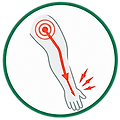


2. Understanding Different Nerve-Related Presentations
Pain that travels into an arm or leg does not always mean that a nerve is damaged or compressed. Different nerve-related presentations can produce similar symptoms. Especially, radicular pain can occur with or without radiculopathy.

Radicular Pain
Affected Structure
-
Spinal nerve root
-
Dorsal root ganglion
Mechanism
-
Neural Gain-of-Function (hyperexcitability and ectopic neural activity), influenced by inflammation, ischaemia or mechanical deformation
Common Presentation
-
Electric, Burning, Tingling, Shooting, Sharp, Stabbing (may resemble dermatomal pattern)
Common Examples
-
Disc herniation
-
Spinal stenosis

Radiculopathy
Affected Structure
-
Spinal nerve root
Mechanism
-
Loss-of-Function of the spinal nerve root due to compression or ischemia
Common Presentation
-
Reduced Sensation
-
Altered Reflexes
-
Muscle Weakness (Feeling Weak ≠ Neurological Weakness)
Common Examples
-
Disc herniation
-
Spinal stenosis

Peripheral Nerve Entrapment
Affected Structure
-
Peripheral Nerves
Mechanism
(Not simply a "Pinched Nerve")
-
Mechanical Loading, Swelling, Local Ischaemia, Blood–Nerve Barrier Disruption, Demyelination, Abnormal Neural Activity, Neuroimmune Responses
Common Presentation
-
Pain, Tingling, Numbness, Pins & Needles, Weakness, Altered Sensation (symptoms may extend beyond the expected nerve territory.
Common Examples
-
Carpal Tunnel Syndrome
-
Tarsal Tunnel Syndrome
Common Questions About Nerve Pain
When Should I Seek Medical Attention?
Most episodes of neck pain are not caused by a serious medical condition, but some symptoms require urgent medical assessment.
🚨 Seek Emergency Medical Care if you develop:
-
New Bladder or Bowel Dysfunction
-
Numbness Around the Saddle or Genital Area
-
Sudden or Rapidly Worsening Weakness
-
Severe or Rapidly Progressive Neurological Symptoms
-
Significant Neurological Symptoms Following Major Trauma
🩺 See Your GP or Seek Prompt Medical Assessment if you develop:
-
Progressive Muscle Weakness
-
Increasing Difficulty Walking or Changes in Balance
-
Loss of Hand Dexterity or Coordination
-
Persistent or Progressive Loss of Sensation
-
Widespread or Bilateral Neurological Symptoms
2. Understanding your condition & Making sense of your pain
Many ankle and foot conditions can sound complicated or concerning. Our goal is to help you understand what may be contributing to your symptoms, what current research tells us about your condition, and what recovery may realistically look like.
Understanding your condition often helps people feel more confident about returning to normal activities, exercise, and sport.


How We Help With Your Nerve Pain
At Evergreen Spine & Wellness, we focus on helping you understand why your knee pain developed and what can be done to improve it.
1. Thorough Assessment
Every person experiences nerve-related symptom differently. Rather than simply looking for something "out of place," our assessment aims to understand what may be contributing to your symptoms and determine the most appropriate management plan for you.

Detailed history

Neurological assessment

Movement assessment
.png)
Strength assessment

Special Test

X-ray if indicated
2. Understanding Your Condition & Making Sense Of Your Nerve Pain
Nerve Pain Is Rarely Influenced by One Factor Alone. We help you understand the factors that may be contributing to your symptoms and recovery.

-
Stress or anxiety
-
Fear of movement
-
Concern about pain or imaging findings
-
Previous pain experiences
-
Confidence in your recovery
-
Muscles, joints, discs and nerves
-
Recent injury or physical overload
-
Movement and physical capacity
-
Previous episodes of back pain
-
Nerve-related symptoms
-
Increased sensitivity to movement or touch
-
Widespread or disproportionate pain
-
Sustained postures
-
Repetitive activities
-
Poor sleep & diet
-
Low physical activity
-
Overall health and wellbeing
-
Other medical conditions
3. Personalised Treatment
Our treatment is tailored to your individual needs and goals. Depending on your condition, care may include hands-on treatment, exercise, education and lifestyle guidance to help you move with greater confidence and return to the activities that matter most to you.

Manual therapy may be used when appropriate to help improve comfort, reduce pain sensitivity, and support movement.
-
Chiropractic adjustment
-
Joint mobilisation
-
Manual stretching
-
Soft tissue therapy

Individualised exercises designed to improve movement, physical capacity, and confidence.
-
Stretching exercise
-
Strengthening exercise
-
Nerve gliding exercise
-
Functional training

Neck pain can be coming from various factors, including stress, sleep, activity, and work
-
Stress management
-
Sleep intervention
-
Activity modification
-
Workstation advice

Helping you better understand:
-
Your pain & symptoms
-
Contributing factors
-
Self-management
-
Recovery strategies
Reference
Ballay, C., Mansfield, C.J., Cook, C.E., Erickson, M., McCormick, Z.L. and Remis, A. (2026) ‘Spine-related leg pain: Definitions, etiology, clinical presentation, and management’, Musculoskeletal Science and Practice, 85, 103623. doi:10.1016/j.msksp.2026.103623.
Dove, L., Baskozos, G., Kelly, T., Buchanan, E. and Schmid, A.B. (2024) ‘Prevalence of weakness and factors mediating discrepancy between reported and observed leg weakness in people with sciatica’, European Spine Journal, 33(11), pp. 4229–4234. doi:10.1007/s00586-024-08330-6.
Finnerup, N.B., Haroutounian, S., Kamerman, P., Baron, R., Bennett, D.L.H., Bouhassira, D., Cruccu, G., Freeman, R., Hansson, P., Nurmikko, T., Raja, S.N., Rice, A.S.C., Serra, J., Smith, B.H., Treede, R.-D. and Jensen, T.S. (2016) ‘Neuropathic pain: An updated grading system for research and clinical practice’, Pain, 157(8), pp. 1599–1606. doi:10.1097/j.pain.0000000000000492.
Finucane, L.M., Downie, A., Mercer, C., Greenhalgh, S.M., Boissonnault, W.G., Pool-Goudzwaard, A.L., Beneciuk, J.M., Leech, R.L. and Selfe, J. (2020) ‘International framework for red flags for potential serious spinal pathologies’, Journal of Orthopaedic & Sports Physical Therapy, 50(7), pp. 350–372. doi:10.2519/jospt.2020.9971.
Fourré, A., Monnier, F., Ris, L., Telliez, F., Michielsen, J., Roussel, N. and Hage, R. (2023) ‘Low-back related leg pain: Is the nerve guilty? How to differentiate the underlying pain mechanism’, Journal of Manual & Manipulative Therapy, 31(2), pp. 57–63. doi:10.1080/10669817.2022.2092266.
Fundaun, J., Kolski, M., Baskozos, G., Dilley, A., Sterling, M. and Schmid, A.B. (2022) ‘Nerve pathology and neuropathic pain after whiplash injury: A systematic review and meta-analysis’, Pain, 163(7), pp. e789–e811. doi:10.1097/j.pain.0000000000002509.
Hage, R., Denis, C., Fourré, A., Finucane, L., Rynkowski, M., Pitance, L., Hoegh, M. and Dierick, F. (2026) ‘Stop guessing: A clinician’s guide to demystifying spine-related arm pain in primary care’, Musculoskeletal Science and Practice, 83, 103549. doi:10.1016/j.msksp.2026.103549.
Hennessy, O., Devitt, A.T., Synnott, K. and Timlin, M. (2025) ‘Assessment and early investigation of cauda equina syndrome: A systematic review of existing international guidelines and summary of the current evidence’, European Spine Journal, 34(4), pp. 1545–1551. doi:10.1007/s00586-025-08732-0.
Kapitza, C., Lüdtke, K., Tampin, B. and Ballenberger, N. (2020) ‘Application and utility of a clinical framework for spinally referred neck-arm pain: A cross-sectional and longitudinal study protocol’, PLOS ONE, 15(12), e0244137. doi:10.1371/journal.pone.0244137.
Khorami, A.K., Oliveira, C.B., Maher, C.G., Bindels, P.J.E., Machado, G.C., Pinto, R.Z., Koes, B.W. and Chiarotto, A. (2021) ‘Recommendations for diagnosis and treatment of lumbosacral radicular pain: A systematic review of clinical practice guidelines’, Journal of Clinical Medicine, 10(11), 2482. doi:10.3390/jcm10112482.
Lehmann, H.C., Wunderlich, G., Fink, G.R. and Sommer, C. (2020) ‘Diagnosis of peripheral neuropathy’, Neurological Research and Practice, 2, 20. doi:10.1186/s42466-020-00064-2.
Schmid, A.B., Nee, R.J. and Coppieters, M.W. (2013) ‘Reappraising entrapment neuropathies: Mechanisms, diagnosis and management’, Manual Therapy, 18(6), pp. 449–457. doi:10.1016/j.math.2013.07.006.
Schmid, A.B., Hailey, L. and Tampin, B. (2018) ‘Entrapment neuropathies: Challenging common beliefs with novel evidence’, Journal of Orthopaedic & Sports Physical Therapy, 48(2), pp. 58–62. doi:10.2519/jospt.2018.0603.
Schmid, A.B., Fundaun, J. and Tampin, B. (2020) ‘Entrapment neuropathies: A contemporary approach to pathophysiology, clinical assessment, and management’, Pain Reports, 5(4), e829. doi:10.1097/PR9.0000000000000829.
Schmid, A.B., Tampin, B., Baron, R., Finnerup, N.B., Hansson, P., Hietaharju, A., Konstantinou, K., Lin, C.-W.C., Markman, J., Price, C., Smith, B.H. and Slater, H. (2023) ‘Recommendations for terminology and the identification of neuropathic pain in people with spine-related leg pain: Outcomes from the NeuPSIG working group’, Pain, 164(8), pp. 1693–1704. doi:10.1097/j.pain.0000000000002919.
Truini, A., Aleksovska, K., Anderson, C.C., Attal, N., Baron, R., Bennett, D.L., Bouhassira, D., Cruccu, G., Eisenberg, E., Enax-Krumova, E., Davis, K.D., Di Stefano, G., Finnerup, N.B., Garcia-Larrea, L., Hanafi, I., Haroutounian, S., Karlsson, P., Rakusa, M., Rice, A.S.C., Sachau, J., Smith, B.H., Sommer, C., Tölle, T., Valls-Solé, J. and Veluchamy, A. (2023) ‘Joint European Academy of Neurology–European Pain Federation–Neuropathic Pain Special Interest Group of the International Association for the Study of Pain guidelines on neuropathic pain assessment’, European Journal of Neurology, 30(8), pp. 2177–2196. doi:10.1111/ene.15831.
Yousif, M.S., Occhipinti, G., Bianchini, F., Feller, D., Schmid, A.B. and Mourad, F. (2025) ‘Neurological examination for cervical radiculopathy: A scoping review’, BMC Musculoskeletal Disorders, 26(1), 334. doi:10.1186/s12891-025-08560-9.
